SD 142 Assignment
Case Study of Three Mile Island
This passage is excerpted from transcripts of the film "Meltdown at Three Mile Island" produced by Chana Gazit and David Stewart, PBS, 1999.
It was built on a sandbar called Three Mile Island, in the middle of Pennsylvania's Susquehanna River, just 10 miles downstream from the state capitol of Harrisburg. The plant's state-of-the-art Unit-2 reactor had been generating electricity for nearly a year. People in the communities surrounding the plant had grown accustomed to the giant concrete fortress. For them, Wednesday, March 28, 1979 began like any other day. They didn't yet know that events leading to the worst nuclear accident in American history had already been set in motion.
It started in the pre-dawn hours with a simple plumbing breakdown. Then a small valve opened to relieve pressure in the reactor. But unknown to the plant operators, it malfunctioned and failed to close. This in turn caused cooling water to drain from the open valve. The nuclear core began to overheat. Confronted by baffling and contradictory readings, the operators shut off the emergency water system that would have cooled the core. So the operators thought they were saving the plant by cutting off the emergency water when, in fact, they had just sealed its fate.
Within minutes, the control room console went wild. Hundreds of lights started flashing, accompanied by piercing horns and sirens. One operator recalled that the console was "lit up like a Christmas tree." There was so much data being dumped to the computer and the process was so slow in getting it analyzed and printed out, that when they'd go to look for data from their computer print-out, it wasn't there until an hour-and-a-half later.
By early morning, the exposed part of the core was beginning to cook. Temperatures in the reactor were already reaching 4,300 degrees. At 5,200 degrees -- meltdown -- a scenario called the "China Syndrome". Operators remained convinced that the core was covered and safe. No one in the control room could see that Three Mile Island was hurtling toward meltdown.
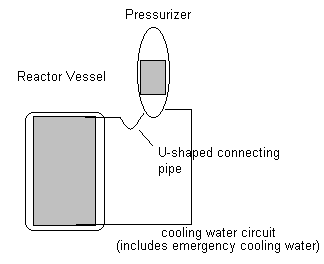
The curious design flaw that caused the operators at Three Mile Island to misread their instruments was a U-shaped pipe that connected the pressurizer with the rest of the reactor. Now this U-shaped junction was necessary. The pipe connecting this tank to the rest of the reactor had to go underneath another pipe. And that U-shape is just like the sink trap in a sink drain. It prevents gas from rising back because there'll be a loop of water in there. And that's what happened in the pressurizer. The pressurizer is a separate tank sitting on top or to one side of the reactor vessel. And it has an air bubble in the top and it's almost full of water, two-thirds full of water generally, and that's how you read the reactor level. That is, in other words, your level gauge is looking at that level in this pressurizer, which is a separate tank. But with this U-shaped connector, it's possible for the water level to be rising as a steam bubble was being created in the reactor vessel. The operators were seeing this water go up and they said, "Oh, my God, where is this water coming from? It must be filling from some unknown source. We don't know what the source is. Let's shut off the emergency cooling," They were afraid that if they let too much water get in there, that there would be no air pressure cushion for a shock absorber. And without that shock absorber, any jolt might fracture one of these pipes and they'd be into a major loss of coolant accident. So they thought they were saving the plant by cutting off the emergency water when, in fact, they had just sealed its fate.
Finally Wednesday evening, an urgent message from Babcock & Wilcox got through to the control room -- get water moving through the core. As soon as the operators restarted the pumps, temperature and pressure in the reactor dropped and stabilized. Sixteen hours after it had begun, it appeared the accident was over. Following the accident, the nuclear power industry would introduce new safety and training standards. But nuclear power would never again hold the promise it once did. Since Three Mile Island, not a single nuclear power plant has been ordered in the United States.
1x1pt 1. When the operators decided to turn off the emergency cooling water, did they make a slip or a mistake?
1x4pt 2. Justify whether it was a slip or a mistake using information presented in the sight passage.
1x16pt 3. Using Norman's Human Action Cycle, explain why the operators turned off the emergency cooling system.
1x4pt 4. Identify the gulf of execution that occurred in the process of turning off the emergency cooling water.
1x12pt 5. Identify four examples of missing feedback from the sight passage. Explain what information was missing, why it was unavailable to the operators (if there is enough information) and how this information could have been provided.
2x6pt 6. The U-shaped pipe connecting the pressurizer to the reactor vessel is described as "a design flaw" in the passage. Actually, this pipe operated completely correctly in the above scenario. Discuss, from a human factors perspective, why the U-shaped pipe is a "design flaw". You may include the reactor vessel and the pressurizer in your discussion. Draw diagrams if needed. A schematic of the pipe has been included at the end of your exam.
1x4pt 7. Propose two design solutions that would solve the design flaw created by the U-shaped pipe. Explain the human factors principles behind your solutions and specifically why they would fix the problem created by the U-shaped pipe. Each solution is worth two marks each.
Simplified design of Three Mile Island.