Midterm SD142 , Spring 2003.
1.
a.
(8 marks) Use the Human Action Cycle to
describe the events in “Set Phasers on Stun”.
Goal: Give proper radiation treat to patient after his surgery for
removal of tumor
Intention: Use Therac-25 cancer
radiation therapy machine
Sequence of Actions: Place patient underneath machine
Go to control room
Enter commands into
keyboard (e for electron beam)
Initiate treatment by
pressing b for turning beam on
Actions: Same as above
sequence, however she pressed “x” instead of “e” , pressed up, edits and
reenters “e” then follows to beam
ready, and presses b
World: Patient hit by massive
radiation, error appears on screen of display,
Perception: Mary Beth sees the
error on her screen but doesn’t see that patient is hit with massive radiation
Interpretation: Mary Beth
thinks that machine hadn’t fired and tries to repeat the procedure again. (does
this 3 times), She thinks patient hasn’t received treatment yet
Evaluation: proper radiation
treatment has not been given to patient but Mary do not know what has happened
in the room. Her goal is not met
Marking notes: Above is the best answer. Some may have different goals or intentions,
as long as the cycle is followed through you got full mark. 1 mark for each
step’s label and description.
Question 1a,1b,1c was marked by: Roshanak
1.
b.
(4 marks) Identify the gulf of evaluation in Set Phasers on Stun.
There is no information on
the state of the world
there is no information to
perceive
there is no information to interpret
there is no information to evaluate.
Marking notes: The best answer was to use the 4 steps of the Action Cycle and refer
to the Gulf of Evaluation in this case study. Above is the best answer. You
could either use the Action Cycle or use the “missing feedback from Machine,
Patient and World for this. You needed to have complete answer in any case.
Therefore you may have comments on your paper but got the full mark.
1.c. (3 marks) What feedback should Mary Beth have
had?
Mary
Beth should have had feedback on
- the state (or mode) of the machine
- the output of the machine
- the state of the patient
These
three pieces of information would have bridged the gulf of evaluation.
Marking note:
Each point is worth 1 mark, and the points are derived from the human interface
model.
2.
In “the Wizards of Wall Street”, the broker sells the wrong amount of stock. Is
his error best attributed to feather analysis or top down processing?
Explain why. (3 marks)
* Key here is best
- This
error is best attributed to top-down processing (1 mark for this)
- Top-down
processing is used to resolve ambiguous situations. Since the broker’s
message could be attributed to either share or $ , the situation was
ambiguous . He did not make any errors interpreting the $, so there was no
problem with feather analysis. (2 mark for explanation)
Marked by Brian
3. a. Bob has decided to skip his 1B co-op term and
instead go gambling in Vegas. He has to
decide between the following casino games.
Use Expected Value theory to decide which game Bob should play. (6 marks)
|
Game |
Potential Winnings |
Probability of Winning |
|
Black Jack |
150, 000 |
.0001 |
|
Roulette |
97, 000 |
.0002 |
|
Craps |
300, 000 |
.00005 |
|
Poker |
250, 000 |
.00007 |
|
Slot machines |
50, 000 |
.002 |
Blackjack EV=150,000*.0001 = $15.00
Roulette EV=$97000*.0002=$19.40
Craps EV=$300, 000*.00005 = $15
Poker EV=$250, 000*.00007=$17.50
Slot machines EV=50,000*.002=$100
By expected value theory, Bob should play Slot machine.
Marking Note: 1 mark for each calculation
and 1 mark for picking the best decision.
Marked by Brian
3. b. (2 marks) Bob has decided that he would like to buy a house in Waterloo to live in. The house he has picked out costs $150, 000. In weighting his options, Bob considers winning $150, 000 or more to be twice as important as winning anything less, since this way he could buy the house. Use this information in a Subjective Expected Utility Model to decide which casino game Bob should play now.
With the new information bob should still play the slot
machine.
Marked by Brian
4. (3 marks) In the following figure, three possible user interfaces for a banking program are shown. With which interface will people move to the second screen the fastest, and why?
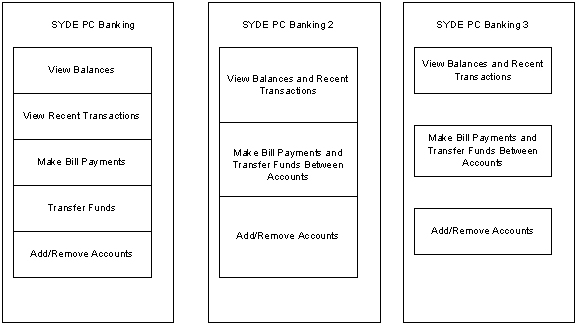
The first interface has 5 choices with small buttons, the
second three choices with large buttons, and the third three choices with small
buttons. Using the Hick-Hyman law, the
3 choice interfaces (2 and 3) will have faster reaction times than the first
one. Using Fitt’s law, the second interface
will have faster reaction times than 1 or 3.
By this argument, the 2nd interface should have the fastest
time.
Marking note: 1 mark for using the Hick
Hyman law correctly.
1 mark for using Fitts Law correctly
1 mark for making the right decision
Marked by Prof Burns
5. (8 marks) In An
Act of God, Bill must make several decisions affecting the distribution of
electrical power to New York City. Describe the four different categories of
biases and discuss how they may have affected Bill's ability to make effective
decisions on the night of the lightning strike in the case study. Be sure to
give examples from the case study.
The 4 biases are input biases,
hypothesis generation biases, hypothesis selection and evaluation biases, and
action selection biases.
For input, Bill weighted the
earliest incoming information heaviest. He did not search very far for
information, including not going to the room that had the right display. For
hypothesis generation Bill had one hypothesis and stuck to it and did not come
up with new ideas. For selection, he rejected Kennedy's alternative, even
though Kennedy was right. For action selection, most people argued that he
talked on the phone rather than taking the necessary actions to correct the
situation, therefore demonstrating not taking action.
4 marks for biases well
explained. 4 marks for connecting them to the story correctly. 8 marks total.
Marked by Prof Burns
6.a. (3 marks) In "In Search of the Lost
Cord", Karen selected the wrong cord. Explain how her working knowledge
created this situation. Explain how a designer could have taken advantage of
working knowledge to prevent this accident.
With working knowledge people are
not as precise. They are only as precise as they need to be. Since the cords
were usually designed to be different and not fit, Karen did not need to
precise about picking the cord. (this explanation was worth 2 marks)
A designer should have made it so
that the cord did not fit. Karen would have recognized that immediately. Worth
1 mark.
Marked by Brian
6.b. (5 marks)
Explain why the electrocution described in “In Search of the Lost Cord” could
be considered a system accident.
In considering a system, one
needs to look at the entire hospital room and the biology of the patient
itself. The important points are
a. proximity between the devices, and in
particular their cords.
b. tight coupling of the human patient with
respect to electrical charge, i.e. it doesn’t take a lot of electrical charge
to change patient state, for the worst.
c.
non-linearities. Once connected there is a nonlinearity
between the power source and the patient.
Possibly a more robust argument are the nonlinearities inherent in
biological systems.
d. common-mode interactions. There are many common mode connections in
biological systems.
e.
limited
ability to isolate components in the patient
f.
multiple
unintended feedback loops in the patient.
g. tightly spaced organs, or proximate steps in
organ systems.
h. Not reversible
i.
No
buffer
There are easily 9 possible
answers, 5 marks for any 5 of these.
Marked by Prof Burns
7. (7 marks)
Explain what “Automation Complacency” is.
Describe its effect on human operators.
Give an example of automation complacency from the film “Why Planes
Crash”.
From the notes, automation
complacency refers to a situation where operators overtrust the
automation. (1 mark)
They fail to monitor it
vigilantly enough, less active / end of
the loop
become less aware of the state of
the system
they are slower to detect
problems
and less able to intervene in a
problem (de-skilling) (4 marks)
An example from the film is when
the pilots focus on the burned out lightbulb.
They assume the plane is in autopilot and stop monitoring the
altitude. By the time they realize the
plane has descended too much they are unable to intervene. (2 marks)
Marked by Prof Burns
Total marks = 52
Previously seen questions =
29/52=56%
New questions that are very close
to old questions = 13/52=25%
Completely new questions = 10/52
= 19%