Overview
Today, seam tracking sensors for welding are very costly for many educational applications, require proprietary controllers, and are bulky in size. The seam tracking device proposed is a smaller, lower cost alternative to the existing devices in the market.
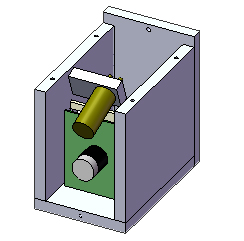
The core technology of the device is being developed such that software algorithms are the primary variable to create a flexible design. Using a laser beam and a camera, seam tracking can be achieved by capturing images of the laser on the joint and processing the data at a low cost to the user. For this project, the analysis of a lap joint is being conducted as a proof of concept. The use of an optical band pass filter allows capturing the light emitted by the laser diode while filtering out ambient light and arc light from the welding process. This optimizes the image processing analysis to ensure a fast response time.
The mechanical design of the sensor is quite flexible and is dependent simply on the component sizes. The primary focus for the project is in the software algorithm design, where the laser line is being analyzed and interpreted to develop a relative position reading.