Research & Projects
- Thesis: Improving Awareness of Automated Actions within Digital Tabletop Interfaces
- Communication and Awareness in Collaborative Shooter Games
- Masters Thesis: a Dynamic User-Centric Mobile Context Model
- Electronic Tax Software
- Schedule Visualization Program for Constructions
Thesis: Improving Awareness of Automated Actions within Digital Tabletop Interfaces (2010-present)
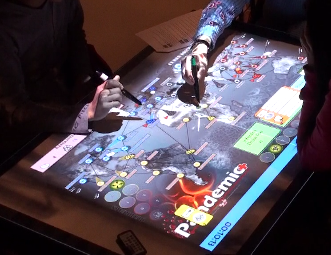
Working around a table with others provides people cues that can be used to maintain awareness of collaborators and the progress of joint work. This collaboration can be enhanced via a digital tabletop display system—a large, horizontal display that enables input directly on its surface. These devices combine the respective advantages of traditional tables and of digital media, and provide the opportunity to automate some of the complex tasks during face-to-face collaborative activities, such as automatic update of dynamic content in a map-based simulation. My research investigates information visualization techniques that improve the awareness of complex automated activities within digital tabletop interfaces. As a case study, I am exploring digital tabletop board gaming as the context to enable rapid design cycles and easy manipulation of variables, such as level of complexity.
To support collaboration in digital tabletop games, features such as keeping track of scores or adding, moving, and removing game pieces can be automated. This functionality allows players to focus more on collaborative tactics during game play rather than the game mechanics. Preliminary work has revealed that automation reduces workload; however, it also increases the potential for confusion, restricts flexibility, and may negatively impact the gaming experience. Through a series of laboratory studies, my dissertation research will investigate the impact on awareness and decision making processes of following three factors: 1) persistent display of automation results, 2) animation of automated actions, and 3) user control of automated actions. Finally, a field study is planned to deploy and validate the design concepts explored in the laboratory studies.
The preliminary result of the exploratory study was published at CSCW 2012 as a poster.
Communication and Awareness in Collaborative Shooter Games (2011)
In the collocated collaborative time-critical shooter gaming, players have to communicate and stay aware of the game state and the partner to develop strategy and successfully complete the mission. In this project, we observe coop first- and third-person shooters game sessions on consoles to investigate how players make use of communication channels and awareness cues. The study revealed that due to the intense nature of the game, players cannot make use of common collocated communication mechanisms such as making eye contacts and gesturing. Instead, players verbally communicate and pay attention to the auditory cues from the partner.
The result of this project was published at CSCW 2012. This project was supervised by Dr. Stacey Scott, and my partner was Victor Cheung.
Masters Thesis: a Dynamic User-Centric Mobile Context Model (2008-2010)
My thesis is focusing on constructing a more complete and user-centric context model
which takes virtual environment into consideration. Most context models focus more
on the system context such as network and device. However, users should be placed
in the center of context-aware systems to provide more adequate services. Unlike
the physical environment where objects have physical presence, objects in virtual
environment do not necessarily have physical presence. When a user is in a video
conference, he/she is in a virtual environment. From the literature review, only
one context model out of the models surveyed have considered the possibility of
a virtual environment. Thus, by considering users as the center of the system and
the possibility of a virtual environment, my thesis will contribute in a more complete
context model. Also, it will reduce the effort put into the implementation by enabling
the model driven approach.
I was co-supervised by Dr. Paulo Alencar and Dr. Dan Berry. The thesis was titled A Dynamic User-Centric Mobile Context Model.
Electronic Tax Software (2009)
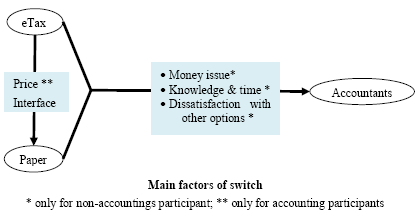
The ubiquitous nature of personal computers and the internet has familiarized people with using various electronic and online services. One such example of this is electronic tax filing software (eTax software). In this qualitative study, we investigate how people perceive and choose their method of filing tax returns. The choices being studied include eTax software, paper tax return forms, and accountants. We also investigate how the general population and accountants differ in their perceptions and the helpfulness of eTax software. Our study focuses primarily on the young adult population, such as students and recent university graduates, who have relatively simple tax returns.
Our results show that most of our participants view eTax software as cheap and convenient, and the potential privacy and security issues like identity theft did not dissuade their preferences. The main factors that motivate people to choose or switch to eTax software include recommendation from others and convenience benefits mentioned above. The results also show that the accountants are less willing to pay for eTax software, value the importance of security more, have greater ability to articulate the functionality of eTax software, and are concerned with correctly filing tax return more. In terms of the helpfulness of eTax software, we observe that eTax software need to take popular corner cases into consideration to provide more tailored services.
The paper is published at the 10th European Conference on eGovernment. You can view the abstract here. This project was supervised by Dr. Edward Lank, and my partner was Nathan Zhang.
Schedule Visualization Program for Constructions (2007)
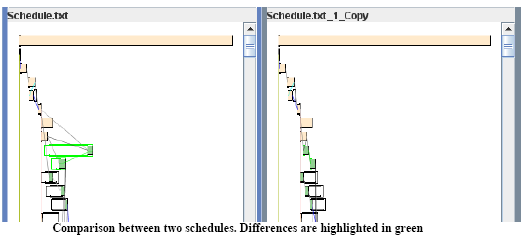
Construction projects involve complicated scheduling issues because the tasks are highly inter-related and dependent. After the initial schedule is set, it still needs to be constantly modified to reflect the real situation. The goal of this scheduling project is to support the frequent alternations of the construction projects. As an Undergraduate Student Research Award holder, I focused on the visualization of the comparisons between schedules and mechanisms to conveniently store and retrieve working history. Moreover, I improved the user interaction design to reduce the potential for error and possible confusion.
This project is innovative in that it is a complete and usable program. It includes both essential utilities functions and advanced visualization features.
I was awarded through the CRA-W CDMP project, and you can read my blog for the project here. The project was supervised by Dr. Melanie Tory.