
Department of Mechanical and Mechatronics Engineering
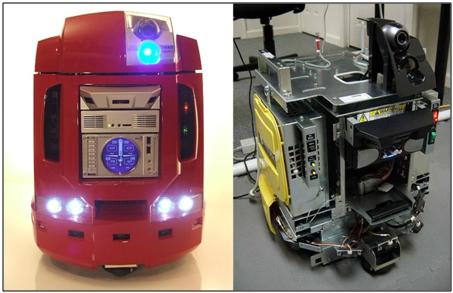
Loss due to fire damage has always been a major area of concern for both
industrial and residential areas. After performing more in depth research, it
was identified that the US Navy has had an increased demand for improved fire
detection technology in order to reduce costs incurred due to fire damage and
false alarms [1]. A formal needs assessment was carried out in order to
determine the design requirements of such technology. Through a problem
formulation procedure, it was determined that the use of an autonomous robot
equipped with advanced fire detection technology can minimize costs, reduce
false alarms, and be highly extensible to other industries. The design of this
system was broken down into three main components: navigation, localization and
fire detection.
For the localization process, during the Initial Training Phase, two techniques
are considered. The first, Manual Placement, involves recording Wi-fi Access
Point Signal Strengths and LASER sensor values at location spaced by 1m
intervals in both horizontal and vertical direction on the area to map, during
‘offline’ mode when the fires are not being detected. The second technique,
Gaussian Process Regression, involves heavily computational stochastic
calculations while the fire-detection is also going on, in ‘online’ mode. Since
Gaussian Process Regression requires significant processing power and may
interfere with fire-detection process, Manual Placement was chosen as selected
technique. For Location Determination, two algorithms: Euclidean Distance and
Monte Carlo were considered. Monte Carlo algorithm is able to give position
information within an accuracy of 0.5m, as opposed to 1m. Since the desired
accuracy is 0f 1m, Monte Carlo algorithm was chosen.
Navigation can be subcategorized into Global and Local Path Planning. Global
path planning involves finding the most optimal path (in a known environment)
from one point to another. Local path planning involves performing fast,
real-time obstacle avoidance. The vector field histogram (VFH) algorithm is
selected for as the local path planner due to its speed, efficiency and local
path optimality. The Wavefront algorithm was chosen as the global path planner
since it is computationally efficient and offers optimal global paths.
The latest high-end fire detection technology was researched in order to
determine which sensor types produce the most accurate results. A variety of
lower-end and higher-end sensors were grouped together in sensor packages, and
evaluated based on a set of cost and performance criteria. Resultantly, a sensor
suite was selected that is comprised of a high-end NetSafety Triple IR flame
detector, a USB nightvision web camera, a Hamamatsu UVTron flame detector, and a
combination photoelectric-ionization smoke alarm. The web camera is to be used
with a custom built vision system using open source vision libraries. A method
of detecting smoke and flames through video is also described with reference to
recent research done on the matter. These sensors readings are all to be
evaluated in parallel in order to have built in redundancy when deciding to
sound a fire alert. This enables the reduction of false alarm signals, and
allows for the detection of most common fires (class A fires) in the most common
locations. Lastly, this system fell within our cost criterion of $5000/unit as
the total system costs less than $4000.
Click Here
to view the 481 Mechanical Engineering Design Report for this Project

Department of Mechanical and Mechatronics Engineering
University of Waterlooo,
Canada N2L 3G1
519 888 4567
http://www.mme.uwaterloo.ca/