
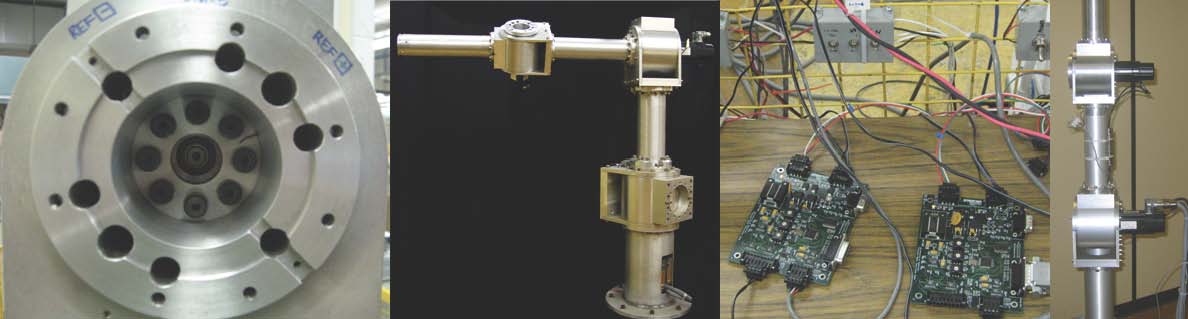
 |
 |
 |
 |
 |
 |
 |
Task-Based Configuration Optimization (TBCO)
The number of distinct kinematic configurations attainable by a set of MRR modules can vary with respect to the size of the module set from several tens to several thousands. Finding the most suitable configuration for a specific task from a predefined set of modules is a highly nonlinear optimization problem in a discrete search space. A main part of research consisted of developing novel Configuration Optimization algorithms for fast and efficient search in the Robot kinematic configuration space to find the most suitable robot for any given task. In specific terms, the goal is to develop and synthesize fast and efficient algorithms for Task-Based Configuration Optimization (TBCO) from a given set of constraint and optimization parameters. The following schematic shows the generic architecture of the TBCO algorithms.
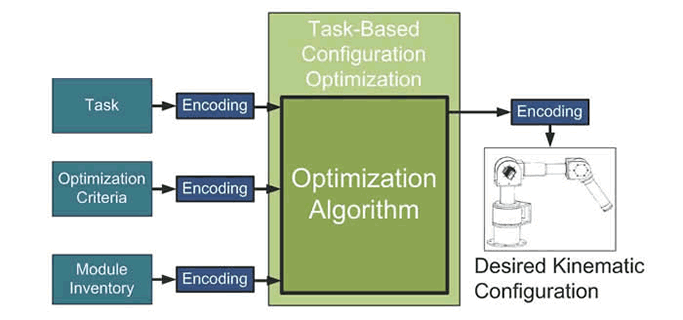
The first set of inputs, module inventory, is the group of available modules. This set determines the size and complexity of the Kinematic Configuration space. The optimization parameters are another group of inputs to the algorithm. These parameters are application dependent and the set of parameters relevant to the tasks are highlighted and selected as the inputs of this stage. The task is the last input to algorithm. The task usually depends on the product or object that will be manipulated by the robot. From the task, a set of the more dominant task points are extracted.
An optimization algorithm is the core of TBCO. This part of the algorithm reads the inputs and finds the optimized kinematic configuration. The previous research has shown that Genetic Algorithms (GA) are the most promising tool to be used as the optimization engine of TBCO. The main disadvantage of using GAs in TBCO is the slow convergence speed. The slow convergence speed, coupled with the processing intensive fitness value calculation in TBCO could result in the algorithm running for days to reach a solution for a problem with medium complexity.
In this research, to increase the performance of TBCO a hybrid Genetic Algorithm, Memetic Algorithm(MA), is used. MAs are algorithms that use local search in conjunction with Genetic Algorithms to increase the convergence speed and solution accuracy of a simple GA. In the proposed TBCO algorithm, in each GA generation local search methods specifically designed for optimization of the dimensions of a manipulator are used to improve the general quality of the population. Preventing the algorithm from premature convergence is an important problem in MAs which has been solved by application specific strategies.